
Last Updated on March 17, 2026 by Satish Mishra
Under Section 40(1) of the RERA Act, 2016, Punjab RERA enables recovery of dues (interest, penalty, compensation) from developers as arrears of land revenue through the Punjab Real Estate Regulatory Authority via District Collectors. This allows for attachment/sale of developer assets using the app.draftbotpro.com and Rerafiling, ensuring swift, mandatory, and often immediate recovery, bypassing civil court delays.
Under Section 40(1) of the Real Estate (Regulation and Development) Act, 2016, any interest, penalty, or compensation awarded by RERA Punjab that remains unpaid is recoverable as Arrears of Land Revenue. This legal fiction allows the authority to use the state’s sovereign power to recover dues through the revenue machinery rather than just civil litigation.
Key Aspects of RERA Punjab Recovery
- Legal Basis: Section 40 of the RERA Act, 2016, read with Rules 16, 24, and 36 of the Punjab State Real Estate (Regulation & Development) Rules, 2017.
- Procedure: Once a recovery certificate is issued, it is sent to the Deputy Commissioner/Collector. The collector or Tehsildar issues a writ of demand, allowing them to attach and sell the developer’s assets under Section 67 of Punjab Land Revenue Act, 1887,.
- Property Attachment: Recent actions show authorities attaching assets, including from government bodies like GMADA, for delayed possession.
- Finality: The amount is recovered as a “sovereign due,” often overriding other creditors and forcing swift settlement by the builder to avoid auction, says The Economic Times.
- Execution: A Decree Holder files an Execution Application with the RERA authority, which then issues a Recovery Certificate, says the Execution Order on the Punjab RERA website.
Disclaimer: The above information is based on public records and general principles of RERA regulation in Punjab.
The Recovery Process in Punjab
- Issuance of Recovery Certificate (RC): The RERA Punjab Authority issues a formal Debt Recovery Certificate.
- Forwarding to District Collector (DC): The certificate is sent to the Deputy Commissioner (DC) of the jurisdiction where the defaulter’s property is located.
- Tehsildar’s Action: The DC forwards the RC to the concerned Tehsildar, who serves a “Writ of Demand” (notice) to the defaulter.
- Enforcement under Punjab Land Revenue Act, 1887: If payment is not made within the specified time, the Tehsildar can employ several recovery methods under Section 67 of the Punjab Land Revenue Act, 1887, including:
- Arrest and detention of the defaulter in civil imprisonment.
- Attachment and sale of the defaulter’s movable and immovable property.
- Attachment of the estate or holding.
Key Legal Considerations
- Sovereign Dues: Treating awards as land revenue arrears means they are handled with the same priority as government taxes.
- Jurisdiction: For projects in areas like New Chandigarh or Mohali, orders are specifically enforced under the Punjab Land Revenue Act, 1887.
- Practical Delays: Despite the power to attach property, actual realization can sometimes be slow. In cases of extreme delay or non-compliance by revenue officials, decree-holders have approached the Punjab and Haryana High Court for a Writ of Mandamus to compel action.
- Interest: Recoverable amounts typically include the principal plus interest, often calculated at the SBI MCLR + 2%
Now that you have got order from RERA Punjab Authority but still clueless what to do next. Then this post will guide you what follows after you have won the case from Punjab Real Estate Regulatory Authority be it refund, interest or compensation.
I know it is complex and time consuming but that’s a part of Indian laws. So if you don’t get it, please feel free to engage a RERA Punjab lawyer in Chandigarh Panchkula Mohali Zirakpur Kharar Derabassi.
Remember there are no free lunches and every service comes at a fee, so be ready to pay it. Else please carry on with Do it yourself (DIY) attitude.
Also Read- What If Builder Doesn’t Comply With Rera Orders?
Go to this link of Revenue Department of Punjab where you will read the entire literature about the recovery process mechanism in Punjab for arrears of land revenue. Here’s the link- t.ly/_DSdA
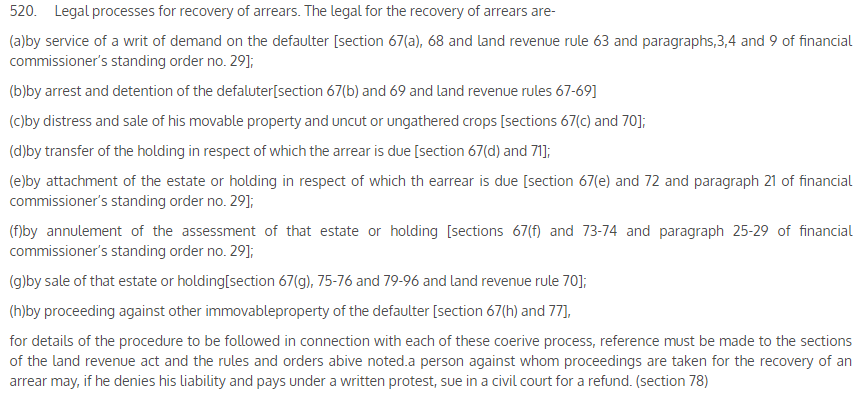
See Section 67 of Punjab Land Revenue Act, 1887 for ready reference.
- Processes for recovery of arrears: – Subject to the other provisions of this Act,
an arrear of land-revenue may be recovered by any one or more of the following
processes, namely: –
(a) by service of writ of demand on the defaulter;
(b) by arrest and detention of his person;
(c) by distress and sale of his movable property and uncut or ungathered crops;
(d) by transfer of the holding in respect of which the arrear is due;
(e) by attachment of the estate or holding in respect of which the arrear is due;
(f) by annulment of the assessment of that estate or holding;
(g) by sale of that estate or holding;
(h) by proceeding against other immovable property of the defaulter;
Follow the image below which clearly explains the process in further detail:
Once the Recovery Certificate is issued by the RERA Punjab Authority, then further process follows:
1 The Recovery Certificate (RC) gets forwarded to DC (Deputy Collector) of the jurisdiction where property of builder is situated which then gets forwarded to Tehsildar.
2 Tehsildar concerned issues “Writ of Demand” and sends notices to promoter-builder for payment of money.
3 If the defaulter builder is unable to pay within specified time period given by Tehsildar, then any of the above actions stipulated u/s 67 of Punjab Land Revenue Act, 1887 can be taken by the Tehsildar.
4 If the builder pays then end of the story. Matter finishes.
Also Read- Arrest in RERA Executions Punjab Haryana Authority
But why it takes so much time? Welcome to India my friend again. Things go at this pace only, especially Punjab. So have patience and pursue on your own in Tehsil with the officials concerned. Since the builders are closely connected with Tehsil officials, they choose to derail the process so that the fruits of your decree are delayed. We even lawyers cannot pressurize these individuals but being a consumer, you can follow up and make them held responsible for delay. So at tehsil level, best is to pursue yourself.
Still in case, the people are adamant and nobody is bothered, then time to go to High Court.
For such officials Punjab and Haryana High Court Chandigarh is ready to issue writ of mandamus. The courts will see why judicial orders are not implemented and who is the person behind the delay. Yes, it takes time and money but that is your call whether to pursue it or not. Don’t be a cry baby and blame it on the advocate.
Always remember- THIS WAS YOUR LAST CHANCE ELSE THERE WAS NO OPTION OTHER THAN LEGAL FOR YOU.
Also Read- Execution of RERA Panchkula Orders
So I welcome thought of sensible clients who do understand the limitations of our judicial system and unnecessarily whine all day about their cases or apathy. This spreads negativity all around.
For all those optimistic ones, in case of any query on the subject matter, please feel free to connect on 99888-17966. For others, please excuse me.
Acts Referred-
1 Punjab Land Revenue Act, 1887
2 Revenue Recovery Act, 1890.
3 All Acts applicable to State of Punjab- t.ly/yH8p
More on 99888-17966.
